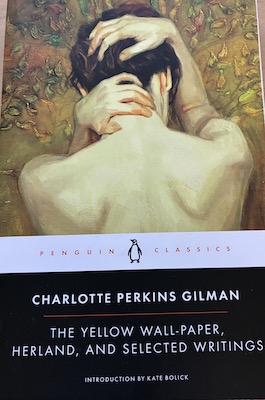
 First published in The New England Magazine in 1892, “The Yellow Wall-Paper” has been a beloved addition to American literature and important entry in feminist prose. In 1899, Charlotte Perkins Gilman included in her collection titled The Yellow Wall-Paper. I first read the story in the 90s, as a student at Eastern Washington University, but I wanted to read it again this year. I found it in the Penguin Classics’ The Yellow Wall-Paper, Herland, and Selected Writings. Though I wanted to read only one story by Gilman, I bought the book because I suspect I will read the other stories. If you don’t want to buy the book, I am sure that your library with have it because it appears in frequent anthologies.
The first-person narrator, along with her husband, has a three-month lease on a country estate, but the yellow wallpaper draws her into a psychotic break. At first, the wallpaper’s pattern fills her with disgust, then horror, and, finally, sympathy. She writes in a journal, I gather, about the wallpaper having eyes and is moving in a menacing manner. She tells us about the smell that permeates the wallpaper and flood the entire house, even the gardens. It’s not unpleasant; in fact, she enjoys it.
I like the smell. It’s the type of detail that adds to the story’s richness and realism. It could have happened! I thought as I read. Gilman wrote in clear sentences, highly relatable, authentic. I understand she took the “rest cure” for Dr. Silas Weir Mitchell, whom she reference in the story, and I imagine it was horrible. It sounds like the type of psychotic dubious treatment inflicted on the woman at the time.
Being a man, I don’t qualify to talk the feminist themes, but I give it a shot. Of her husband, John, the narrator writes: John laughs at me, of course. but one expects that in marriage.Note the preposition she uses, at, not with. We all know the feeling of being the bunt of some sick joke. Maybe the joker tells us he is laughing with not at us, but there is always a confession it that statement. He jokers knows the joke was against the victim. For that reason and other, I see John as the primary antagonist.
The contribution to feminist literature is one reason the story stands out for me, but it’s not the only reason. Other themes include the living with a creative mind in the otherwise prosaic world, and there is the battle with depression in it. No question about it, the narrator, who remains nameless, was suffering from a mental health issue from the start. That surprised me in this reading because I remembered her as sane at the start, but insane at the end. She’s worst at the end, but she suffered from the beginning.
Born Charlotte Perkins in Hartford, Connecticut, she was the daughter of Frederic Beecher Perkins, a man of letters. Shortly after her birth, her father left, so she was brought by her mother, Mary. She loved running, which she did daily, and trips to the gymnasium. She attended the Rhode School of Design, but she dropped out before finish. There were rumors of a lesbian relationship in her twenties, but in 1884, she married to Charles Walter Stetson. The marriage was unhappy. She escaped to California, where she had another lesbian affair. She also divorced Stetson, but they remained friends. In 1900, she married George Houghton Gilman, a cousin, and stayed married until his death. She died by suicide in 1935.