
Say you live in San Francisco. You get up one day and decide to play with your binoculars. You went to the window and aimed them at Corona Heights, and there you saw a man on the summit waving at you. 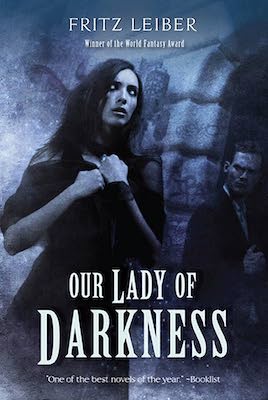 Curious, you decided to meet him and find what his deal was. You hiked to the summit, but it since that took an hour or so, the man was no longer on the hilltop. Why would he be? Still with your trusty binoculars, you found your apartment window, but when you did, that same man was in your apartment. He stopped to wave at you.
Such is the beginning of Our Lady of Darkness. Franz Westen is the man who experiences that scene. At forty-some, he suffered from the death of his wife, Daisy. He dealt with the tragedy by turning to alcohol, but he is done with that now, and he is ready to move on with his life. With that in mind, he is dating the young woman who lives two floors below him, Cal, short for Calpurnia, and he has made friends with other neighbors, Gun and Saul. For money, he writes horror and fantasy novels and a television show, Weird Underground. He is a man who suffers setbacks but determine to have a good life.
Then he spots a man on the summit of Corona Heights!
The common event sends him on a mission to discover who he was. Franz has a hobby, of sorts, to learn all he could by the writer Thibaut de Castries, who wrote Megapolisomancy: A New Science of Cities. He believes that the man on the hill is a clue, but he doesn’t know how he is connected.
Our Lady of Darkness is horror literature; at least, I found in the horror section of my library. I went there looking for a book because I am reading a nine-hundred page tome; a good novel, for sure, but as a break from it, I wanted a novel I could finish in a week. Our Lady of Darkness is a horror novel, but it is quiet horror, low-key. It’s funny, in a way, but mostly it explores the mind of the grief-ridden Franz Westen.
Fritz Leiber knows that mind well—or he did, having died in 1992. Having lost his wife in 1968, he turned to alcohol. And like the protagonist, he loved fiction. So I think he wrote Our Lady of Darkness to exorcise his grief and to celebrate the talented writers in history. The title, for example, comes to us from Suspiria de Profundis by Thomas De Quincey, the author of Confessions of an English Opium-Eater. I had read Suspira de Profundis, but I remember little about it. It also inspired the 1977 movie Suspira (remade in 2018). Leiber referenced this book in the novel, but he also referenced Jack London, Ambrose Bierce, H. P. Lovecraft, and other writers. He even referenced earlier works by himself, “The Black Gondolier” and “Diary in the Snow.” I laughed at the scenes in which he attributed his own work because it was too funny. Can we say metafiction?
As for Thibaut de Castries and his work, Megapolisomancy, they are fictitious. So is the journal Franz Westen is reading by, he suspects, Clark Ashton Smith. However, Smith (1893-1961) was an actual writer who wrote short stories and poetry. He specialized in “weird stories.” In the fictitious journal, the writer, whether it’s Smith or someone else, is besotted with de Castries, even an acolyte of his. Acolyte is the right word, because de Castries’ believers became a cult. And that’s the mystery Franz Westen is trying to solve.
I believe every reader should come up with their theme, but for me, it’s transition. Franz changed from a grief-ridden widower to a man looking forward to the rest of his life, from an alcoholic to man in recovering, from man obsessed with the mystery of the journal to a man who is willing to let the mystery die.
The word of the book is pieta dura, which is a craft that cuts polished, colored stones and fits them in to create images in mosaic. Leiber used it in the following sentence: But about the Black Bird—you’ll recall what I told you of de Castries’s pietra dura ring of mosaicked black semiprecious stuff depicting a black bird? The scene is Byers, another expert about de Castries, is explaining his history to Franz Westen. I found this exposition dump a weakness of the novel, but it was interesting and answered several of Franz’s questions.
Sometimes Our Lady of Darkness is funny, and sometime it’s tragic. Sometimes it’s mysterious, but horrifying? I didn’t find it so, not even in the climax scene. But the climax, though not horrifying, made sense in Franz Westen life. Though it was not scary in the conventional sense, the book was always entertaining.


