 Novel Review
London bored Richard Hanney. Though a Scotsman by birth, he grew up in Rhodesia, where he became a mining engineer and prospector. But London was too tame for his taste, so he planned to leave it to seek adventures elsewhere. Then, he met a fellow tenant, Franklin P. Scudder, who told him he had uncovered an assassin plot against the Greek prime minister in London to take place on the 15th of June. For reasons of his own, he didn’t want to involve the police. Hanney told him he could stay with him for a few days. A few days later, coming home from an engagement, Hanney found that Scudder was dead, killed with a knife. Hanney instantly realized two things: the police would assume he was the culprit, and the assassin plot was real. He needed to stop it.
Fearing he was being watched at his apartment, Hanney disguised himself as a milkman to escape. He fled to Scotland, where he met various men to help him, including a roadman and Sir Henry. The police and Black Stone, a conspiracy of assassins, also pursued him. In the sky, a monoplane searched for him. Since the novel was written in 1914, on the eve of World War I, the plane looking for him was a new threat. The date of June 15 was at the back of his mind. How would he escape capture long enough to stop the assassination of Constantine Karolides?
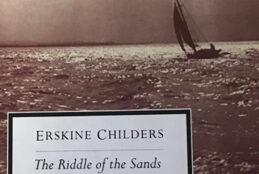
The Thirty-nine Steps is a spy thriller. I had been reviewing spy novels for years, fulfilling my plan to survey spy literature throughout history, but unfortunately, my stroke delayed that survey. Now, I am back to it. I started the survey in May 2020 with James Fenimore Cooper’s The Spy, and I added to the list The Riddle of the Sands by Erskine Childers last August. In between them, I read several spy novels, but The Thirty-nine Steps is the most action-packed of them all.
John Buchan used the “wrong man” trope to build suspense. Perhaps he invented the trope—probably not—but having both the police and Black Stone looking for him heightened the tension. I recognized the trope from Alfred Hitchcock’s North by Northwest, but when I mentioned that to Chatgpt, it reminded me that Hitchcock adapted The Thirty-nine Steps into a movie. Hitchcock loved the wrong man trope. I’ve never seen the movie version of the novel, but it’s probably good because the story is so cinematic.
Richard Hanney wasn’t a spy. He was a mining engineer. But he improvised several stories during his travels. Once, when he fell into Black Stone’s grasp, he made good use of engineering knowledge to escape. Against him were the police, who ran pictures of him in the newspapers, and the Black Stone, who knew that he was using the moors of Scotland to hide. They had the monoplane hounding him.
John Buchan was both successful in his literary life and in public service. Born on August 26, 1875, in Perth, Scotland, he was the son of a minister, Reverend John Buchan, and Helen Masterton Buchan. He attended the University of Glasgow and Brasenose College at Oxford. He married Susan Charlotte Grosvenor in 1907. They had four children. He published his first novel, Sir Quixote of the Moors, when he was 19. Richard Hanney was the protagonist of four novels: Greenmantle, Mr. Standfast, The Three Hostages, and The Island of Sheep. He became Baron Tweedsmuir in 1935, and he was appointed governor general of Canada. He held the position until he died on February 11, 1940.
The Thirty-nine Steps is a fun read, and since it is short, you should be able to read it in two or three days. High literature? Probably not. I think of it as a palate cleanser to read between more serious novels. As I am sure that Buchan intended it to be.