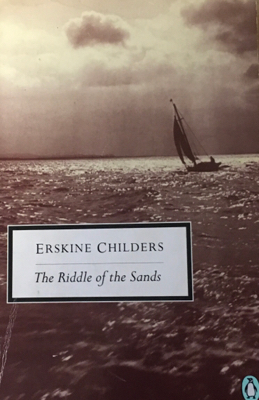
 In The Riddle of the Sands, published in 1903, 11 years before the Great War began, Erskine Childers envisioned the preparation for a war between Great Britain and Germany that we recognize could have happened. I take it as a cautionary tale. When nations want to war with each other, they will find a way. And often, fiction writers will pick it up and write the narrative of their opinion before the war happens. As Erskine Childers did. Of course, World War I happened, and knowing of the war, we know that Childers’ vision didn’t happen. But it could have happened, which makes The Riddle of the Sands an interesting and suspenseful read.
Bored and upset that his vacation was scheduled in the off-season, Charles Carruthers received an invitation to go yachting in the Frisian Island. The invitation came from Arthur Davies, an old schoolmate. Carruthers envisioned a leisure and luxury cruise, equipped with deckchairs and stewards to bring him drinks, but he found the Dulcibella, a thirty-foot converted lifeboat, and the crew was Davies and…and…and Carruthers. Imagine his shocked! He decided to make a bad situation better by sailing with Davies for a couple of days and spending the rest of his vacation touring Germany.
But Davies had an agenda. In the weeks he spend in Germany waters, he had a run-in with the owner of a German yacht, of the style Carruthers first envision he was going cruise on, and during the confrontation, Davies developed the idea that man wasn’t German. He was an Englishman! It was just a hunch, but if true, the question became: Why is it pretending to be German? When Dollmann, the man’s name, tried to kill Davies, Davies became convinced he had nefarious designs against the British Crown. He convinced Carruthers to join him in the investigation.
The investigation, as Davies saw it, contained two fronts. The sands around the Frisian Island and the Atlantic coast of Germany made navigating the region very challenging. At low tide, only a few channels were open. In case of war, Davies—not being asked by anyone—set out to map the channels, giving the novel its name. The second concerned Dollmann. What was he up to? Neither man was a spy. Carruthers worked at the Foreign Office, writing precis for review by higher-ups. What did Davies do? The novel never says. I imagine he did what we saw him do; he was a man sailing for sport. He loved it!
En route, we met Dollmann and his daughter, Clara, the commander of the German patrol boat, von Brüning, and the friendly Bartels, the captain of a supply boat. As captain of the galliot Johannese, he aided Davies out of a dangerous situation. We also met the mysterious engineer, Böhme.
Galliot, of course, is my word for the novel. Common on the Dutch and German coasts, they were wide-beam craft with a round hull, carrying everything from grain to livestock to bricks. They had a shadow draft, perfect for navigation the sandy coast, but they were also sturdy enough to survive frequent groundings. Chatgtp compared them to farm wagons, and on the coast, where it is easier to travel by sea rather than the land, they were just that.
I’d be remiss if I didn’t see the novel as a travelogue. Few novels have given me the urge to travel the land and waters like The Riddle of the Sands. Norderney, on the Frisians, gives the wayward traveler a place to relax while he enjoys modern restaurants and shops. Across a channel lies Juist, nicknamed the long island, where the visitor feels isolated. Windswept sand dunes greet the visitor. I see myself sitting on the beach and watching the sunset and contemplating the meaning of life. On the mainland, the Kaiser Wilhelm Canal, now the Kiel Canal, invites the sailor inland, passing cities and farmland to the city of Kiel. Davies and Carruthers enjoyed a leisurely night on the canal, socializing with Bartels. They endured a friendly interrogation in Norderney by Commander von Brüning. Every site they visited, I want to see.
Usually, when reviewing spy novels, I talk about the tools, weapons, and gadgets that made the spy successful. I also talk about the skills they have. But for The Riddle of the Sands, they used no gadgets or weapons. Dulcibella, itself was the only tool they used. The cramped, thirty-foot converted lifeboat sailed to every place they cared to go and allowed them to see everything they needed to see. It was cramped! Scene after scene, Davies and Carruthers struggled to make things fit. What comedy that appeared in these pages was usually based on two men existing in a space that one would feel squeezed to live in.
Davies’ knowledge about tides, currents, sandbars, buoys, weather, and other navigation aids served as the list of skills. He was a sailor. A very reckless sailor, but a sailor, nonetheless. As I said, it seemed to be the only thing he did. In a scene, he navigated a small dinghy in a thick fog to Memmert, one of the Frisian Islands. As Carruthers rowed, Davies navigated. It is an impressive chapter; it alone is a good reason to read The Riddle of the Sands.
As for Carruthers, he was a sneak. As Davies was good at sea, Carruthers, a landlubber, was good at land. When they reached Memmert, Carruthers found a hut where he overheard details of what the conspirators were up to. In another scene, he went to the mainland, disguised himself as a German seaman, and learned more details.
And talking about skills, the skill of friendship should be mentioned. Carruthers, at the beginning of the novel, felt lonely. He feared that his friends had deserted him to enjoy their vacation without him. And Davies, well, as Carruthers described him, was dull. But they formed a friendship that, I suspect, will endure. They also formed friendships with Bartels, von Brüning, and Clara, Dollmann’s daughter. Do I hear a romance booming between Clara and Davies? Well, maybe if Davies could escape his social awkwardness, and if Clara wasn’t the daughter of an English traitor. Just my thoughts!
Born in London in 1870, Erskine Childers knew tragedy earlier as his parents died when he was young. He was raised in Ireland. As a young man, he attended Trinity College and joined the British Civil Service. When the Second Boer War broke out, he enlisted and served as an artilleryman. He married Molly Alder Osgood in 1904. She was as adventurous as he was, and together they sailed the Frisian Island. They had one son, Erskine Hamilton Childers, who was elected the Irish president in 1973, but he died in 1974. (Story there?) Childers, the father, was executed in 1922 during the Irish Civil War. His crime: he possessed a handgun given to him by Michael Collins.
The Riddle of the Sands is his only complete novel. It is a spy novel, but it also a sea adventure. Athough Germany in the Great War never used the strategy Chillers described, they could have used it. Who knows? Maybe they tested it out the way Chillers envisioned in The Riddle of the Sands.