 Novel Review
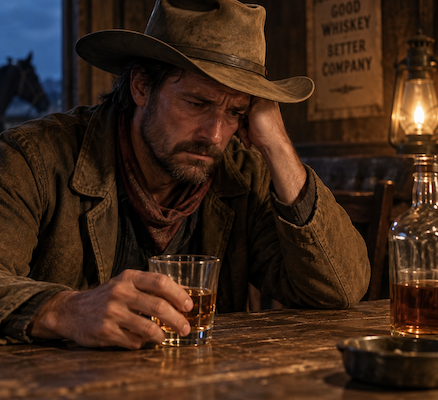
One day in Bridger’s Wells, two cowboys came to relieve themselves of the tension of managing a herd of cattle. One of them, Art Croft, the narrator, passed the time of the ride by watching chipmunks and jays play or noticing how blue the sky is. Once they reached town, the other, Gil, proved himself more playful. He traded jests with the bartender, Canby, and wanted to know if “his girl,” Rose Mapen, was around. Alas, the good women had chased her out of town. At a poker game, he developed a rivalry with a player named Farnley. When Farnley accused Gil and Art of rustling, the disagreement came to fisticuffs. Gil won, but Canby knocked Gil out with a bottle of whiskey. No worries about a concussion. I guess Gil had a thick skull, because when he came to, he laughed about it. Hilarity pursued. But a teenage rider rushed into town with sobering news. Rustlers had killed a cowboy named Kinkaid.
The Ox-Bow Incident is about a lynching. Some characters were for it; others, against it. Make no doubt about it: The lynching of three men took place at the part of a mountain pass called Ox-Bow. That is a spoiler, I guess, but the novel isn’t about that act. It’s about the men who carry out the lynching and those who opposed them. Thematically, it’s about justice. Is it served by a bunch of angry cowboys armed with a rope, or is it served by a court of law? One is immediate and certain; the other takes time and the outcome is uncertain.
The chief proponents were Farnley and Major Tetley. Farnley was a friend of Kinkaid, so grief and anger consumed him. It was easy to understand his rage. It’s the reason we don’t let victims of a crime serve on the jury. Their emotional bias is not easily overcome. Major Tetley was a former Confederate commander. Dressed in the old Confederate uniform, he saw hunting down and punishing the rustlers as a way to relive the glorious days of the Confederacy. His argument was about order. Not law and order. Just order. If he believed in justice, it was frontier justice.
The opponents were Sparks, Gerald Tetley, and Arthur Davies. Sparks was a black man who witnessed the lynching of his brother. He knew firsthand the pain and injustice it caused. As the major’s son, Gerald rode with them as an obligation to his father, but he was against the lynching. He told Art that if they went through with it, he would kill himself. Arthur Davies, the owner of the general store, made the case against the lynching to a man named Winder. Davies explained:
“If we go out and hang two or three men…without doing what the law says, forming a posse and bringing the men in for trial, then by the same law, we’re not officers of justice, but due to be hanged ourselves.”
This is as good a time as any to tell my word of the story. It is posse. From Hollywood westerns, I know what a posse is, or thought I did, but the novel distinguished between the posse and the mob. In the book, a posse is an official body, designed to obey all laws, used to bring fugitives back to stand trial for their aligned misdeeds. It comes, like many legal terms, from Latin, from posse comitatus, meaning “the power of the county.” The mob got around that by having the deputy deputize in the mob, but as Judge Tyler pointed out, only the sheriff could deputize the men. The sheriff was out of town.
Justice in the theme, and it’s clear that Clark felt that lynching is not how it is achieved. There is a scene towards the end of the novel that makes that clear. I jumped when I read it. Jump as if I were reading a horror novel! I will not tell you more because it’s a spoiler, but I suspect you will know it when you read it.
Except for the scenes that take place in the saloon and one scene that takes place in Judge Tyler’s house, this is an outdoor novel. The dust around Bridger’s Wells, the cold air of the mountain pass, the eerie silence of the Ox-Bow—they are as much a character as Art and Gil. How I longed to be riding with them—not to lynch somebody, never to lynch somebody—but to feel the mighty horse beneath me, to enjoy the camaraderie of the group, telling tales of bravery around the campfire. Ah yes, that’s the life for the city-slicker I am!
We met Rose Mapen, but she had married since Gil knew her, and she was going back to Bridger’s Wells as a sign of her victory. They encountered a stagecoach on the mountain pass, and she and her husband were passengers. The coach mistook the men for robbers, and the guard took a shot. I won’t tell where the bullet hit, but I will tell you the description of the wounds being cauterized made me queazy.
Though Walter Van Tilburg Clark was born on August 3, 1909, in Maine, his family moved to Reno, Nevada, when he was eight. His father was the president of the University of Nevada. Clark took his bachelor’s at that university, but he earned his master’s at the University of Vermont. In 1930, he married Barbara Morse, and they had four children. The Ox-Bow Incident, published in 1940, was his first novel, but he wrote The City of Trembling Leaves and The Track of the Cat. In 1950, he published a short story collection entitled The Watchful Gods and Other Stories. Then he stopped publishing fiction. In 1962, he became the writer-in-residence at the University of Nevada. Cancer claimed him on November 10, 1971.
The Ox-Bow Incident is a novel about a lynching and the moral consequences that follow it. It is about justice, as defined by lawyers, state leaders, and the courts, and it is about frontier justice, as defined by a mob armed with a rope. The novel is beyond good, even beyond great. It is sublime. It is a must-read.