 Novel Review
For years, I thought Wuthering Heights would be a love story, and I avoided reading it because of that. I have nothing against love stories, but I rarely read them. I thought it was about Heathcliff and Catherine’s love for each other. A recent trailer for a movie inspired by the novel, showing a couple embracing and sharing a passionate kiss, helped the misconception. Seeing the trailer, I decided that it was time to read Wuthering Heights. I made that decision despite that image, not because of it. Did I find love between Heathcliff and Catherine? Yes, there was love. But there was more rage. Rage consumed Heathcliff.
Wuthering Heights by Emily Brontë is a complex tale of love, revenge, sorrow, and rage. It follows its protagonist Heathcliff as he strove for revenge against all who harmed him—and some who were innocent bystanders. Most of the persons Heathcliff harmed were what the military calls collateral damage. He was vicious, and in his rage, he didn’t care who suffered or why.
Heathcliff was the adopted son of Mr. Earnshaw. After a trip to Liverpool, Earnshaw returned with Heathcliff wrapped in a blanket. He and his wife already had two children, Hindley and Catherine. As they grew, Hindley and Heathcliff developed a rivalry, but Catherine and Heathcliff became fond of each other. Even loved each other. But when the time came for her to find a husband, she chose Edgar Linton of Thrushcross Grange. That wasn’t the first time the neighbouring Lintons insulted Heathcliff, but it was the time that mattered. From the day Catherine said “I do” until the end of the novel, Heathcliff swore he would claim his pound of flesh.
What followed took him two generations to achieve. To frame the story, it’s told in the first-person narration of Mr. Lockwood, who learned the details from his servant Nelly Dean. Lockwood rented Thrushcross Grange a year after the events of the drama played out. He was a curious person who insisted on knowing all the dirt on his neighbor and landlord. That Heathcliff was in possession of Thrushcross Grange, which used to belong to the Lintons, told Lockwood that a story needed to be told. Nelly, a servant to both families, knew the story.
Is Heathcliff a Byronic hero? To who has never heard of a Byronic hero before, a Byronic hero is a main character who has mysterious origins and enormous passions, but who is alienated from society, rebellious, and self-destructive. Earnshaw found Heathcliff in Liverpool, where no one knew, according to Earnshaw, whose child he was. Mysterious origins, check. As for his being passionate, when a character Heathcliff valued died, he released a roar so loud that many thought it was a beast of the woods or the moor. For sure, Heathcliff had a dark nature. So he is a candidate for a Byronic hero.
But we shouldn’t be so quick to romanticize Heathcliff. Throughout the novel, he had hanged a dog, kidnapped, forced a woman into marriage, and committed other deplorable acts. He is not an antihero; he is the villain of the novel. He is also the protagonist. Brontë excused nothing, but she wanted to explain him to readers, made us understand him.
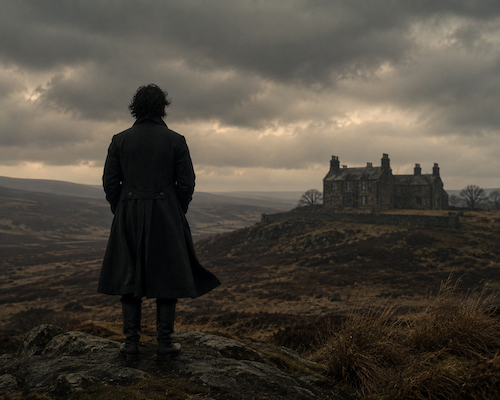
And there is no understanding Wuthering Heights without understanding the moors. Dark, gloomy, frequent by fog and wind, isolated, and strangely beautiful—Heathcliff loved the moors; at least, he understood them. In contrast to the woods that surrounded Thrushcross Gange, which felt warm and inviting, the moors were barren and crag-ridden. Cold? Yes, the moors were cold as Heathcliff’s heart. The perfect representation of Heathcliff.
My word of the novel is orison, which simply means a prayer. Brontë uses it bit of irony because she pairs orison with curses in the following passage:
A more elastic footstep entered next; and now I opened my mouth for a ‘good-morning,’ but closed it again, the salutation unachieved; for Hareton Earnshaw was performing his orison sotto voce, in a series of curses directed against every object he touched, while he rummaged a corner for a spade or shovel to dig through the drifts.
Patrick Bontë, a clergyman, and his wife, Maria, gave birth to a literary family, who included Charlotte, Anne, and Emily. In the year 1847, all three were published within a few months of each other. Charlotte wrote Jane Eyre; Anne, Agnes Gray, and Emily, Wuthering Heights. Emily knew death early in her life. Maria died when Emily was 3. Two older sisters, Maria and Elisabeth, died when a disease broke out at the Clergy Daughters’ School, where both Charlotte and Emily also attended. Her one brother, Branwell, died in 1848, just three months before Emily’s own death, and seven months before Anne’s death. Emily was 30. She never married.
Wuthering Heights is the only novel she published. But with her sister Anne, she created the fictional world called Gondal, with its history, politics, and characters. It was something they did as children; I am not sure how late in life they practiced this hobby. Along with writing Wuthering Heights, Emily was an accomplished poet. Among others, she wrote “Remembrance,” “The Prisoner,” and “No Coward Soul Is Mine.” You can find these lines in “No Coward Soul Is Mine:”
No coward soul is mine
No trembler in the world’s storm-troubled sphere
I see Heaven’s glories shine
And Faith shines equal arming me from Fear
I neglected Wuthering Heights for so long because I thought it was a romance, but nothing is farther from the truth. It is the story of a multigenerational revenge. In Heathcliff, Emily Bontë created a villain that is believable and, strangely, understandable. But not forgiven! No way forgiven! I now count Wuthering Heights as one of my favorite novels, and I consider it a must-read for anyone who desires to understand literature.