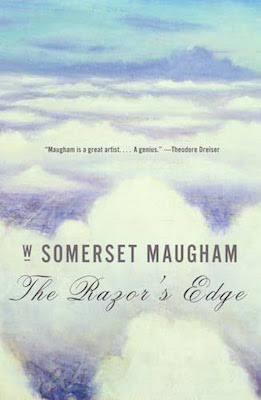
 We all know a Larry Darrell in our lives. My Larry was a community of Sixties radicals and war protestors who, shunning society expectations, migrated to Northeastern Washington State, to Onion Creek, to live as homesteaders in the modern world. I, a modern man, didn’t enjoy living among them, but my parents ran Onion Creek Square, and I stayed with them for two years. It was years after the Vietnam War, so I don’t know what their politics were, but each one was unique. They live without power, running water, or a phone. If you need to get ahold of anyone, you came to the Square and leave a note with my parents. Much the way you would leave a message at the Parisian American Express for Larry. What W. Somerset Maugham considered rare in 1944, when he published The Razor’s Edge, had been relatively commonplace during the 1980s, when I lived in Onion Creek.
The comparison is not entirely accurate because Larry Darrell wanted “to loaf” through life. Though he had money through his investments, it was not enough to satisfy the woman he was engaged to, Isabel. She, like her Uncle Elliott and her mother, craved a better life, defined by material comforts and social position. I trust you see the problem, the conflict that drives the novel.
This is a British novel, but the characters are Americans, and many scenes are set in Paris. You have an Englishman, Maugham, writing about Americans, Larry and Isabel, about life in Paris. Call it an international novel! Or is it a novel? Maugham, a character in the book, said, If I call it a novel it is only because I don’t know what else to call it.
I know this story because this is the third time I’ve read the book, and because there was a Bill Murray movie based on the book. I saw the movie before reading the book the first time, but I found the book better. Larry, a veteran of World War I, returned home a changed man. In the war, a friend had lost his life saving Larry’s life, and that event had placed Larry in a reflective mood. He refused to go to college or to work at a job. He spent his days at the gentlemen’s club reading books. All books! Any book! That was he meant by loafing. It’s a beautiful life—one I want for myself—but Isabel had issues with it. Reading, unfortunately, pays nothing. She worried about her material wants. Her place in society. When Larry went to Paris to loaf, she vowed she would give him a couple of years to sort his priorities.
Not to give anything away, he never did!
The Razor’s Edge starts in 1919 or 1920 and ends in the middle of the 1930s. In other words, it is set during Prohibition and the Great Depression. I would consider it a Jazz Age novel, but since it takes place mostly in Paris, I didn’t get much sense of those events. In the 30s, Larry began dating the alcoholic Sophie and became engaged to her. Isabel, now married to Gray Maturin, became jealous. For me, the contest between the women was spine-tingling. I hate Isabel for it!
W. Somerset Maugham, a character in the novel and its narrator, not a moral absolutist, didn’t hate her. A bisexual, he was married to Syrie Wellcome, but he kept men as “secretaries” for serious relationships. He was a discreet sexual adventurer. As “the most famous writer in the world,” as his biographer Selema Hastings calls him, he became rich. After he medical school, he spent some time practicing medicine, before he discovered the seduction of writing. In the 1910s, he was an agent for British Intelligence, and afterwards, he wrote his Ashenden stories, an inspiration to Ian Fleming’s James Bond novels. Other noteworthy works include the short story “Rain,” set in Pago Pago, and On Human Bondage. He died in 1965.
The word of the novel is concupiscence, a strong desire. Maugham uses it to describe Isabel’s lust for Larry. During a drive home, he describes her:
She was so still you might have thought her hypnotized. Her breath was hurried. Her eyes were fixed on the sinewy wrist with in little golden hairs and on that long, delicate, but powerful hand, and I have never seen on a human countenance such a hungry concupiscence as I saw then on hers.
I bought The Razor’s Edge at a bookstore, but I don’t remember if it was at Auntie’s Books (a Spokane bookstore) or at Barnes and Noble. It cost me $17 in trade paperback. Amazon has it as a Kindle for $11.99. It is one of the most popular novels Maugham published, only On Human Bondage in more popular, I think, so it should not be hard to find, either new or used.
Though depressing, The Razor’s Edge is an enjoyable and thought-provoking read. In the novel, Maugham said that the book tells “a success story,” but I suspect he meant it facetiously, because to judge anything in the book as successful is a stretch. But maybe I’m wrong. The characters in The Razor’s Edge do not behave in a good way, but at the same time, they did nothing so bad as to inspire blame. No good-versus-evil here. They are just living life in the best way circumstances determine.