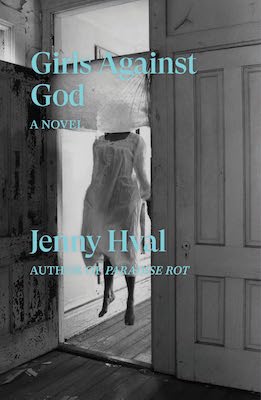
 Though I read Girls Against God twice, I confess to you I don’t get it. So I am going to spend this review struggling to make sense of a novel I find nonsensical. And please know, when I say I don’t get it, I don’t mean I don’t like it, for I found it an interesting, thought-provoking tome. I read it twice already, and I know I’ll read it again. And could be that I wasn’t supposed to get it, that it wasn’t written for me, that it’s loaded with so many feminist ideals and imagery that the misogynist in me can’t grasp it. But I am going to try anyway.
Who is Jenny Havl? She’s a Norwegian singer who also writes novels. I don’t know anything about her music, and this novel is all I can judge her literary ambitious on, but judging for the numbers of albums she had released, she is successful. According to Wikipedia, one influence she has Kate Bush. I tell this in hopes, perhaps futile, that helps get you a clue about her music. She was born on July 11, 1980.
Three young women, Terese, Venke, and the narrator, I, form a band and play gigs. Though they are inspire by the musical style know of black metal, they come after it. The women consider themselves as witches, and they conduct rituals and have rites to prove it. Or maybe, it’s shared delusions. They hold rehearsal and talk amongst themselves. They talk about Nocturno Culto and Varg Vikernes, two black metal musicians. Vikernes committed murder, and that fact fascinates the women. They also talk about a painting, Puberty, that depicts a teenaged girl, naked, sitting on the bed, casting an eerie shadow on the wall. It was painted by Edvard Munch, best know in the States for his The Scream. They talk about all things dealing with art, its creation, its presentation. And the best I can tell that is the theme—art, musical, film, literary, and visual.
Alternatively, it is a monologue, almost a lecture, where I, the narrator, tell us what she thinks about art, language, and womanhood. Since these things include all manner of tropics, she rambles, introducing and reintroducing subjects at random. In this version, the theme, from her fascination with black metal to the paintings of Edvard Munch to her fascination with pornography, is rage. She is interested in language, in the silent H in the word white, in the similarity between band and bond, and the Southern Norwegian Dialect. She rages all of it. In every word in the novel, you can feel rage seeping from her. I wrote a friend that in reading this book, I realized that in high school I was a Goth. I don’t think the Goth existed back then, if they did then I should’ve belonged it. I don’t know if Hval or her character is Goth, but the rage she feels is Goth-like,
For instance let me reference Puberty. Munch painting symbolized vulnerability, But she images the figure coming to life in the modern world. Pale, emaciated, fearful, she blames Munch for painting her at her most vulnerable time of her existence. For giving the world this image of her. Exposing her for others to see. Interpreting her thoughts and feelings in this private time. She rages against the painter and all viewers who discussed about the painting.
Where does God come into it? The first lines read:
I hate God.
It feels primitive and pitiful to say it, but I’m a primitive and pitiful person.
It is a couplet, metaphorically. It doesn’t rhythm, but one sentence completes the other. The narrator is not an atheist. I am an atheist, and I don’t hate God. You can’t hate an entity you don’t believe in. I might hate the concept of a god, but that is not what she saying. She hates God. A controversial, even a blasphemous thing to say, but saying it she does. I hate God. And what not to hate? Noah’s flood? The Mark of Cain, which did a fine job to deter every murder since then? The existence of evil? God, if He exists, has a lot to answer for! I mean, what about Lot’s wife. A pillar of salt? Really? She hears a commotion behind her, and she turns to see what it is—who wouldn’t—and suddenly, she becomes salt. Is that fair? Is it just? Not the least bit. And Hval’s narrator gets it.
Although I didn’t understand this novel, it gave me a lot to think about, and perhaps that is intention. Most novels tell you a story, and from the story, you determine the theme. But in Girls Against God, the enter novels is the theme. And that it’s genius. Should you read Girls Against God? I don’t know, but if you do, you find a lot to think about.